Personal AGI: the short answer
A personal AGI is a general model you rent, wired to context you own, doing your work. The model is a commodity and the wiring is open source, so the context is the only part that is actually yours, and most of it was never written down. That unwritten part is dark context, and it decides whether the assembly works at all.
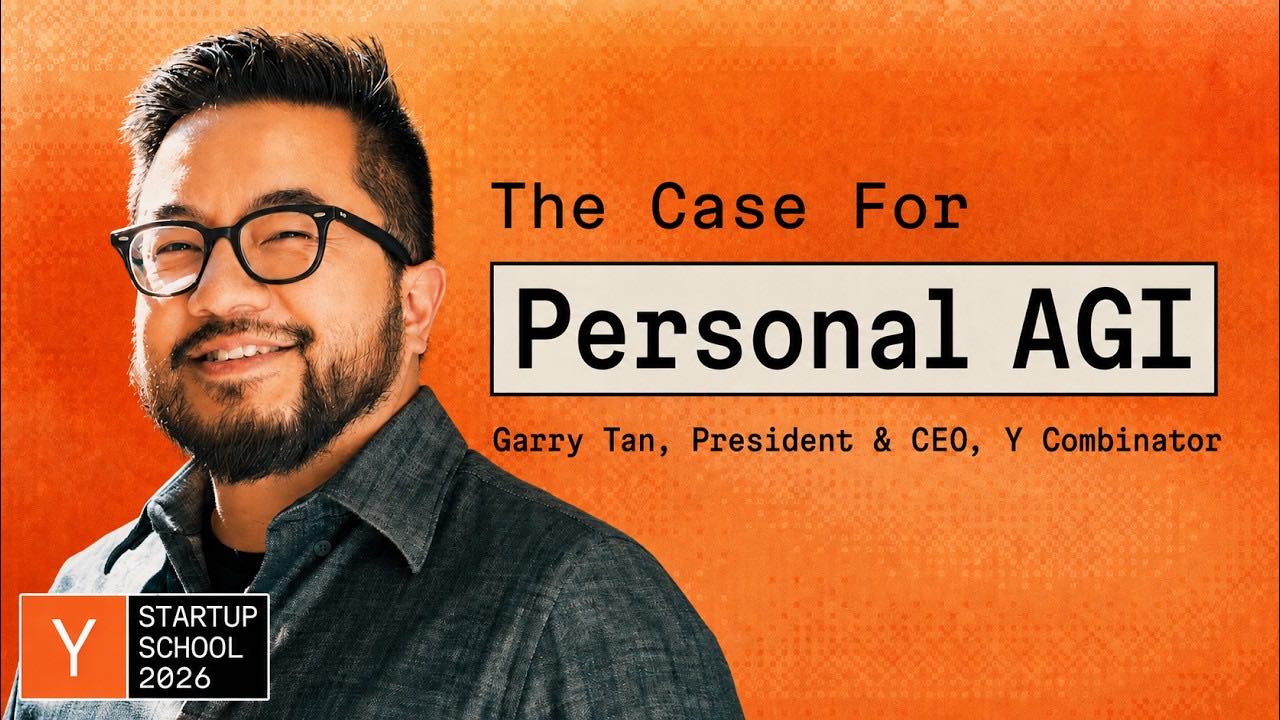
The term was put in front of a large audience by Y Combinator's Garry Tan in August 2026, and the argument travels well beyond the talk. Anyone assembling one runs into the same three questions in the same order: what goes in it, what happens when a second person is involved, and what keeps it from going stale.
What is a personal AGI made of?
Three parts: a frontier model you rent, context you own, and a harness that wires them together. Nothing in that list is artificial general intelligence as the phrase is usually meant. It is an agent that knows your situation well enough to do your work, which is the version that changes anything.
The assembly matters less than the ownership. Two people can run the same model through the same open-source harness and get answers that are not comparable, because only one of them has written down how the work actually goes. The other is asking a stranger.
Why is context the only part you own?
Because the other two terms are priced to zero and the third is not for sale. The frontier model is rented, and it gets cheaper every quarter; Tan calls his own "rented and a commodity." The harness is open source, and the people who build the good ones give them away. Weights and wiring are everyone's.
Everything rented is intelligence.
Everything you can own is context.
That leaves one term, and it is the one that compounds. A year of the model getting better is a year everyone gets. A year of your own context getting sharper is a year only you get. When you switch providers, it comes with you, because it never belonged to the provider.
What context does a personal AGI actually need?
The situated kind: one page per project and one page per person you work with — what you are building together, what they care about, what you owe them. Tan's phrasing for why this works is exact: it is "stuff no model on earth has, because it only exists in your head."
Anything a model already has is not worth writing down, and anything worth writing down is, by definition, not written down yet. The useful context is the tacit layer: judgment you cannot fully put into words, the workaround everyone knows, the reason a rule exists. A general model knows almost everything in general and almost nothing about you.
What happens when more than one person is involved?
The architecture stops answering. A personal AGI is one person deep — one founder, one repo, one library, one set of keys — and the security model that makes it safe is custody: keep it yours, do not share it. That is correct advice for the individual, and it is the opposite of what an organization needs from the same person.
Tan's own illustration makes the edge visible. Maya, a support engineer, teaches her agents forty skills over two years. In one ending the files live in her repo and she leaves with compounding judgment. In the other they live in the company's repo, and "she didn't have a career, she had an extraction." Same files, same Maya, one variable: ownership.
Custody is why the company case is hard.
Not why it is solved.
Both endings are solitary, and there is no third panel where Maya's forty files serve the twelve people around her and still belong to her. This cuts against the thing we sell: our work starts at the moment knowledge has to leave one head and become something a team can use. Keeping it yours is the right advice, and that is why the company case is hard, not solved. Some offers answer it by pooling: put it all in one shared system, capture everything, one searchable brain. That is the second ending with better tools. We do not have a clean answer either.
Does a personal AGI stay accurate?
No. It decays unless someone curates it: "a brain nobody curates is a garbage dump with great search," as Tan puts it. Knowledge drifts from green to gray to dark, and the drift has its own anatomy.
Green context is current, findable, and answers when you ask. Gray is the org chart from before the reorg, still confidently served. Dark is where the drift ends. Capture is an event; staying green is work, and it is the work most personal-AGI setups quietly skip.
Can't I just export my notes and email?
You get part of it. An export harvests what was already written down, which is real and worth having. It never touches what was never said out loud, what was said and never captured, what was captured and then lost, or what sits behind a fence you cannot reach.
Those are four different kinds of dark, and an inbox export drains only the shallow end. Treating the export as coverage is the most common way a personal AGI ends up confidently generic: the same failure a retrieval pipeline hits, for the same reason.
How does this relate to dark context?
Dark context names the material a personal AGI runs on: what an organization knows but never wrote down — the situated context a general AI model cannot see. The personal-AGI recipe makes the boundary unusually easy to see. Everything on the near side is rentable; everything on the far side is the reason your version is worth anything.
We (Ola Möller and Andriy Zhukov, at Dark Context) coined the term by analogy to dark matter: the unseen mass that holds the visible structure together. A personal AGI is one person's attempt to reach it for themselves. The organizational version of the same problem is where it stops being a solo project.
Questions people ask
What is a personal AGI?
A general model you rent, wired to context you own, doing your work. It is not a more powerful model; it is the same model, given the situation. The rented intelligence is a commodity; the context is what makes the output yours rather than generic.
Is personal AGI the same as artificial general intelligence?
No. AGI in the usual sense is a capability threshold in the model. Personal AGI is an assembly: commodity intelligence plus your own context plus a harness. It arrives diffused rather than as an event, and it is available now because the hard part was never the weights.
Why is context the only part you can own?
Because the model is rented and gets cheaper every quarter, and the harness is open source and given away. Neither is a moat for anyone. Your context is the only term in the equation that does not arrive identical for everybody, and the only one that compounds with use.
Can I build a personal AGI by exporting my notes and email?
Partly. An export gives you what was already written. It cannot give you what was never said out loud, what was said and never captured, what was captured then lost, or what sits behind a fence you cannot reach. Most of the context that matters is in one of those four.
Does a personal AGI work for a team?
Not as designed. The architecture is one person deep and its security model is custody: keep it yours, do not share it. That holds for a solo operator and breaks the moment a second person is involved, because organizational context lives in heads, hallways, and inboxes that no one person can export.
How is this different from RAG?
It is the same boundary seen from the other side. RAG retrieves from what your organization wrote; a personal AGI is one person deliberately writing more of it down first. Both stop at the same place: the unwritten layer. Getting past it is a capture problem, not a retrieval problem.
The whole idea
The knowledge that actually runs your company was never written down. We call it dark context. A personal AGI is one person reaching for their own; the organizational case is the one still open.
Read the Dark Context manifesto →darkcontext:~$want your AI to know the company?
A short call, not a sales pitch. Bring one process that only works because a specific person is in the room. Together we will work out whether that dark context is worth surfacing, and what it would take.
book a calldarkcontext:~$get updates via email
Leave an email instead. No pitch, just the occasional note as we map where dark context shows up and what helps bring it to the surface.